
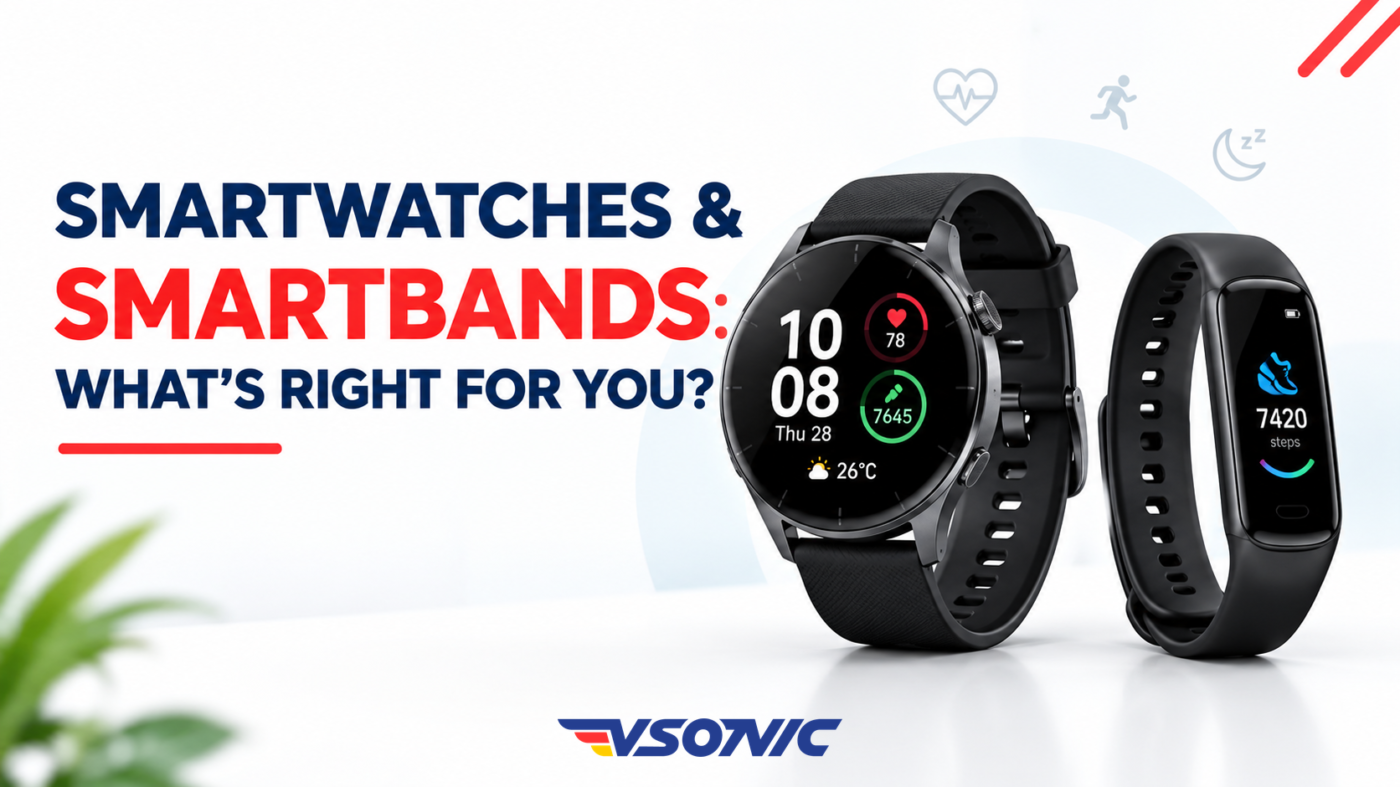
Wearable technology has changed how people monitor daily activities, manage notifications, and stay connected. From counting steps and tracking workouts to checking incoming calls, smartwatches and smartbands offer convenient features that fit into everyday life.
However, choosing between them can be confusing. Some smartwatches offer advanced communication tools and customisable apps, while many smartbands focus on lightweight comfort, fitness tracking, and longer battery life.
So, which should you choose? The answer depends on your lifestyle, budget, fitness goals, and the features you genuinely need.
In this guide, we explore the differences between smartwatches and smartbands, compare their essential features, and explain how to choose the right wearable for your needs in Nigeria.
1. What Is a Smartwatch?
A smartwatch is a wearable device that combines timekeeping with smartphone-style features. Depending on the model, it can display notifications, track fitness activities, monitor selected health indicators, control music, and run compatible applications.
Some models support Bluetooth calling, while others offer cellular connectivity, allowing certain functions without a nearby smartphone.
Benefits of smartwatches
Advanced connectivity: Many smartwatches display calls, messages, app notifications, and calendar reminders. Selected models also allow users to answer calls or respond to messages.
Versatile fitness tracking: Depending on the device, features may include step counting, workout tracking, heart-rate monitoring, sleep tracking, and built-in GPS.
Customisation: Many smartwatches support interchangeable watch faces, different straps, and various compatible applications.
Convenient everyday functions: Features such as alarms, timers, music controls, navigation prompts, and contactless payments may be available on supported models and in supported regions.
Limitations of smartwatches
Smartwatches can cost more than basic fitness bands, particularly models with advanced sensors, GPS, cellular connectivity, or premium materials.
Their battery life also varies considerably. Some require charging every day or every few days, while others last substantially longer. Larger displays and frequent use of connected features can increase power consumption.
2. What Is a Smartband?
A smartband, also called a fitness band or activity tracker, is generally a lightweight wearable designed primarily to monitor everyday activity and selected fitness or health indicators.
Smartbands typically feature a narrow display, a comfortable strap, and a relatively simple interface. Many connect to a smartphone through Bluetooth and synchronise recorded data with a companion application.
Benefits of smartbands
Lightweight comfort: Their compact designs make them suitable for people who prefer a less noticeable wearable, including during exercise and sleep.
Fitness-focused features: Many track steps, distance estimates, calories burned, heart rate, sleep patterns, and selected workout activities.
Potentially longer battery life: Because many smartbands have smaller displays and fewer power-intensive features, they can last longer between charges than many full-featured smartwatches.
Budget-friendly options: Basic smartbands are often more affordable than feature-rich smartwatches, although prices and capabilities vary by manufacturer.
Limitations of smartbands
Smartbands generally offer fewer applications, communication options, and advanced functions than full-featured smartwatches.
Some have small displays that can make reading messages less convenient. Others depend heavily on a connected smartphone for GPS data or detailed activity analysis.
If you want a wearable that functions as an extension of your smartphone, a basic smartband may not provide everything you need.
3. Smartwatch vs Smartband: Key Differences
The following comparison highlights the main differences between these two wearable categories.
| Feature | Smartwatch | Smartband |
|---|---|---|
| Primary purpose | Connectivity, convenience, and fitness | Activity tracking and fitness |
| Display | Generally larger and more interactive | Usually smaller and simpler |
| Smartphone notifications | Common, often with more interaction options | Common, but interaction may be limited |
| Calling | Available on selected models | Limited or unavailable on many models |
| Applications | Broader support on many models | Usually more limited |
| Fitness tracking | Available across many models | A central feature |
| GPS | Built-in on selected models | Often relies on a phone, though some include built-in GPS |
| Battery life | Varies; some need frequent charging | Often longer, depending on features |
| Comfort | Varies with size and design | Often lightweight and compact |
| Cost | Wide range, including premium models | Often affordable, especially basic models |
These are general tendencies, not universal rules. Some advanced smartbands offer features associated with smartwatches, while some entry-level smartwatches have limited functionality.
4. Fitness Tracking and Health Features
Both devices can help you understand your activity levels, but their tracking capabilities depend on the specific model.
Step counting and daily activity
Smartwatches and smartbands commonly track steps and estimate daily activity. They can help you set goals, monitor consistency, and build healthier movement habits.
However, step counts and calorie estimates are not perfectly accurate. Treat them as general indicators rather than exact measurements.
Heart-rate monitoring
Many wearables use optical sensors to estimate heart rate. This can be useful during exercise or for observing general trends.
Accuracy varies with the device, fit, movement, skin characteristics, and activity. Do not assume that every wearable provides medical-grade measurements.
Sleep tracking
Selected models estimate sleep duration and patterns using movement and other sensor data. These estimates may help you recognise changes in your routine, but they are not a substitute for professional assessment of sleep disorders.
GPS and outdoor exercise
If you run, cycle, or walk outdoors, GPS can help record your route and distance.
A smartwatch with built-in GPS can record routes without necessarily relying on your phone. A model that uses connected GPS typically needs your smartphone nearby.
Before purchasing, check whether GPS is built in or phone-dependent.
5. Battery Life, Comfort, and Compatibility
Beyond the headline features, three practical considerations can make a major difference to your experience.
Battery life: Consider how often you are willing to charge your wearable. If you travel frequently, spend long days away from charging points, or want to track sleep overnight, battery life may be particularly important.
Comfort and fit: A large smartwatch may offer a more readable display but feel bulky on a smaller wrist. A slim smartband may be more comfortable during workouts or sleep. Check the strap material, weight, and available sizes.
Smartphone compatibility: Confirm that the wearable supports your phone’s operating system and that its companion application is available and compatible with your device. Some features may work only with particular phone brands or operating systems.
For Nigerian users, also check whether replacement straps, chargers, and other accessories are reasonably accessible. If you intend to use calling or payment functions, confirm that the specific model and your local services support them.
6. Which Wearable Is Right for Your Lifestyle?
The best choice depends on what you want your wearable to do.
For fitness enthusiasts
A smartband may be sufficient if your priorities are steps, workout tracking, sleep estimates, and lightweight comfort.
If you need built-in GPS, more detailed workout tools, or a broader range of sports features, compare suitable smartwatches and advanced fitness wearables.
For busy professionals
A smartwatch may be more convenient if you frequently check calls, messages, appointments, and reminders throughout the working day.
Choose a model with notification controls and compatibility suited to your smartphone and work routine.
For students
A smartband can be a practical starting point for activity tracking and basic notifications. A smartwatch may be more suitable if you want additional applications, interactive notifications, or other everyday tools.
Your budget and the features you will actually use should guide the decision.
For everyday users
If you mainly want to count steps, monitor activity, check the time, and receive occasional notifications, a smartband may provide everything you need.
If you prefer a larger screen, more customisation, and broader connectivity, consider a smartwatch.
For people who want fewer charging interruptions
A smartband may be a good option because many models prioritise lower power consumption. However, battery performance varies, so compare the manufacturer’s estimates and independent testing where available.
7. What to Check Before Buying
Before choosing a smartwatch or smartband, consider these important factors:
- Compatibility: Verify support for your smartphone and operating system.
- Battery life: Compare expected usage time and charging requirements.
- Water resistance: Check the actual rating and the manufacturer’s guidance for swimming, showering, or other activities.
- Display quality: Consider readability in bright outdoor conditions and ease of navigation.
- Sensors: Confirm that the device includes the specific tracking features you want.
- GPS: Determine whether it is built in or depends on your phone.
- Calling and notifications: Check which functions work independently and which require a smartphone connection.
- Durability: Review materials, strap quality, warranty terms, and replacement-part availability.
- Total cost: Consider accessories, replacement straps, and charging equipment as well as the initial purchase price.
Avoid paying extra for features you are unlikely to use. A well-chosen basic wearable can be more useful than an expensive device that does not suit your routine.
8. Frequently Asked Questions
Is a smartwatch better than a smartband?
Not necessarily. Smartwatches generally offer broader connectivity and more interactive features, while smartbands often prioritise lightweight comfort and activity tracking. The better option depends on your needs.
Do smartbands track heart rate?
Many smartbands include optical heart-rate sensors, but not every model does. Check the specifications before buying and remember that readings may not always be accurate.
Can a smartwatch work without a smartphone?
Some smartwatches support standalone functions through cellular connectivity or built-in GPS. However, many features still require a compatible smartphone for setup, synchronisation, or full functionality.
Which has better battery life?
Smartbands often last longer between charges, but battery life depends on the model, display, GPS usage, notification settings, and other features.
Can smartwatches and smartbands replace medical devices?
No. Although some models offer health-related measurements, consumer wearables should not automatically be treated as medical devices. Consult a healthcare professional about symptoms or medical monitoring needs.
Conclusion: Choose the Wearable That Works for You
Smartwatches and smartbands both offer practical ways to stay connected, monitor activity, and build more consistent daily habits.
A smartwatch is generally the stronger choice if you want a larger display, broader connectivity, and more interactive features. A smartband may be better if you prefer a lightweight design, straightforward fitness tracking, and potentially longer battery life.
Before making your decision, compare compatibility, battery performance, comfort, available features, and overall cost. Focus on what will genuinely improve your daily routine rather than simply choosing the device with the longest feature list.
Ready to explore wearable technology? Visit VSONIC.NG to discover available technology products and accessories for your lifestyle, fitness goals, and everyday connectivity needs.