
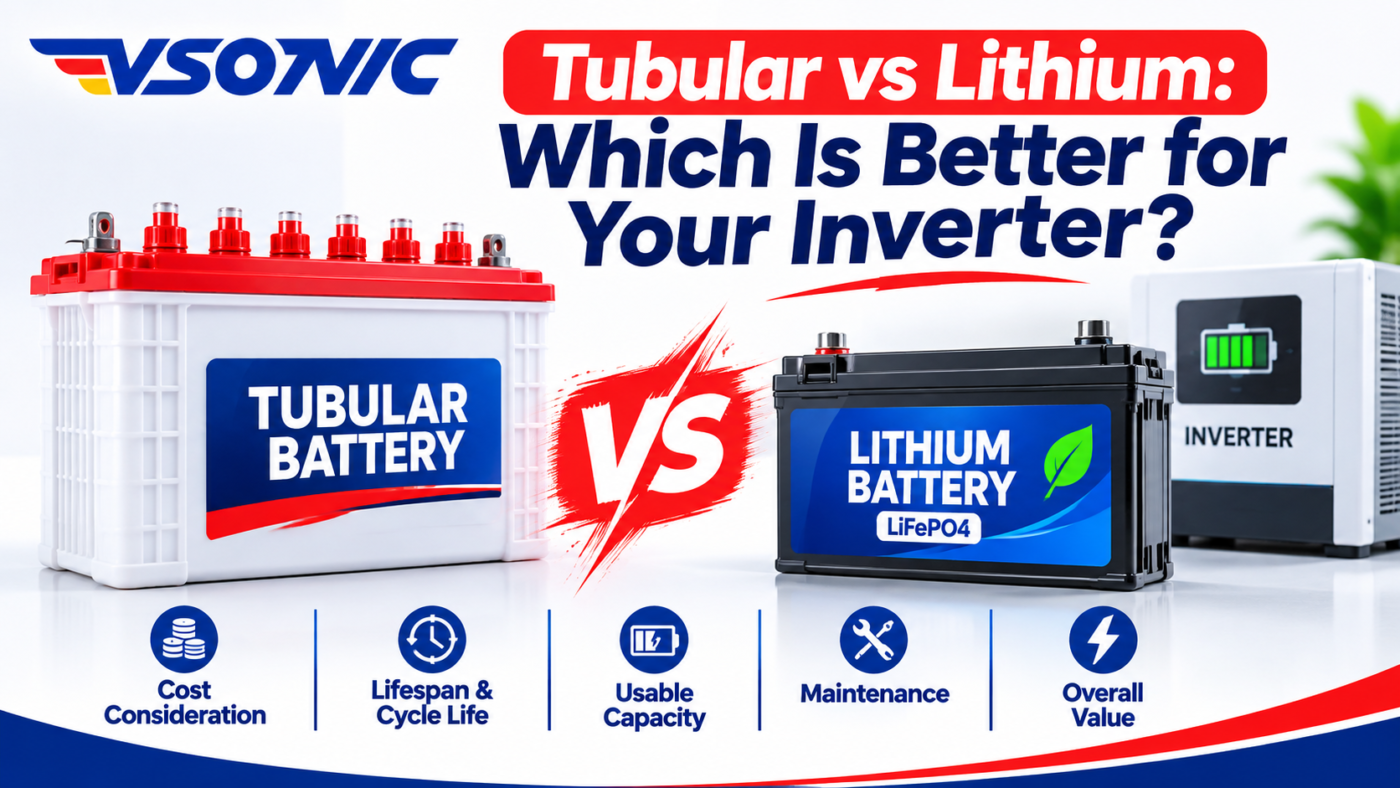
Choosing the right battery can make a significant difference to how well your inverter performs, how long your appliances stay powered and how much you spend on backup electricity over time. If you are considering an inverter for your home, office or business, you have probably come across two popular options: tubular and lithium batteries. When comparing tubular vs lithium batteries, which one offers better value? Is it worth paying more for lithium, or can a tubular battery still meet your power needs?
Both options can support inverter systems, but they differ in usable capacity, charging requirements, maintenance, lifespan and upfront cost. This guide explains the differences to help you make a more informed buying decision in Nigeria.
1. What Is a Tubular Inverter Battery?
A tubular battery is a type of deep-cycle lead-acid battery designed to handle repeated charging and discharging.
It uses tubular positive plates to support its construction and performance during regular cycling. This makes it suitable for inverter and backup power applications.
Many Nigerian homes and businesses use tubular batteries because they are familiar, widely available and generally less expensive to purchase than comparable lithium systems.
However, flooded tubular batteries require periodic maintenance, including checking electrolyte levels and topping up with distilled water when the manufacturer recommends it. They also need suitable ventilation because charging can release hydrogen gas.
2. What Is a Lithium Inverter Battery?
For this comparison, we are focusing on LiFePO4 (lithium iron phosphate) batteries.
These rechargeable batteries are designed for energy storage and are increasingly used in residential solar and inverter installations.
Unlike conventional flooded tubular batteries, LiFePO4 batteries generally include or require a Battery Management System (BMS). This system monitors battery conditions and helps protect against issues such as overcharging, excessive discharge, overcurrent and temperature-related problems.
Lithium batteries also offer relatively high usable capacity, compact installation and lower routine maintenance requirements.
Their main disadvantage for many buyers is the higher initial purchase cost.
3. Tubular vs Lithium Batteries: Key Differences
Here is a practical comparison of the two battery types.
| Feature | Tubular Battery | Lithium (LiFePO4) |
|---|---|---|
| Battery chemistry | Lead-acid | Lithium iron phosphate |
| Initial cost | Generally lower | Generally higher |
| Usable capacity | Often planned around 50% discharge for longer life | Commonly supports deeper discharge, subject to specifications |
| Charging | Requires a compatible lead-acid charging profile | Requires compatible lithium charging settings |
| Maintenance | Flooded models require electrolyte checks and distilled water | Generally minimal routine maintenance |
| Weight | Heavy | Generally lighter |
| Cycle life | Generally lower under comparable deep-cycling conditions | Generally higher under suitable operating conditions |
| Battery management | Usually no integrated electronic BMS | Requires an appropriate BMS |
| Installation | Requires suitable ventilation for flooded models | Requires suitable installation and protection |
| Best suited for | Buyers prioritising lower upfront cost | Buyers prioritising frequent cycling and long-term use |
The exact specifications vary between manufacturers and models. Always compare product datasheets rather than assuming every battery of the same type performs identically.
4. Usable Battery Capacity: Which Gives You More Power?
One of the biggest mistakes buyers make is comparing batteries using only their voltage and amp-hour (Ah) ratings.
The more useful question is: How much of the stored energy can you actually use?
Depth of Discharge (DoD) describes the percentage of a battery’s rated capacity that has been used.
For planning purposes, flooded lead-acid batteries are commonly sized around 50% DoD to support longer service life. Many LiFePO4 batteries permit deeper discharge, often around 80%, depending on the manufacturer’s specifications.
Consider this simplified example:
A 12V, 200Ah battery has a nominal energy capacity of:
12V × 200Ah = 2,400Wh (2.4kWh).
- Tubular at 50% DoD: Approximately 1.2kWh usable energy.
- LiFePO4 at 80% DoD: Approximately 1.92kWh usable energy.
Although both batteries have the same nominal capacity, the lithium example provides more usable stored energy.
These figures are illustrative and exclude inverter losses and other system limitations. Actual usable energy depends on the battery’s discharge limits, load and operating conditions.
5. Battery Lifespan and Cycle Life
How long will your inverter battery last?
There is no universal answer because battery lifespan depends on the product, charging conditions, temperature, discharge depth and frequency of use.
However, lithium batteries generally have an advantage when an inverter system is charged and discharged frequently.
A battery cycle refers to the use and replenishment of stored energy. Repeated deep discharging can shorten battery life, particularly when the battery is not designed for that operating pattern.
For example, Victron Energy publishes the following cycle-life figures for its Lithium Smart battery range:
- 2,500 cycles at 80% DoD.
- 3,000 cycles at 70% DoD.
- 5,000 cycles at 50% DoD.
These are manufacturer-specific figures, not guaranteed performance figures for every lithium battery.
Tubular batteries also have different cycle-life ratings depending on their construction and operating conditions. Always request the manufacturer’s cycle-life information and the conditions under which it was measured.
6. Charging Speed and Power Availability
Charging performance is another important consideration, especially in areas where grid electricity is inconsistent.
Lithium batteries can generally accept higher charging currents than comparable lead-acid batteries, provided the battery and charging equipment support them.
This can be useful when you have limited charging windows or want to make better use of available solar energy.
However, switching to lithium does not automatically make an inverter charge faster.
The actual charging speed depends on:
- The battery’s maximum recommended charging current.
- The inverter or solar charge controller’s charging capacity.
- Available grid, generator or solar power.
- Battery temperature and state of charge.
- The charging profile configured for the battery.
Check these specifications before purchasing. A battery capable of accepting a high charging current will not benefit from it if the inverter cannot supply that current.
7. Maintenance and Installation Requirements
Tubular and lithium batteries have different maintenance requirements.
Tubular batteries
Flooded tubular batteries require periodic inspection. Depending on the manufacturer’s instructions, you may need to check electrolyte levels, top up with distilled water and keep terminals clean.
They should also be installed in a suitable, well-ventilated location because charging can produce hydrogen gas.
Lithium batteries
LiFePO4 batteries generally require less routine maintenance. However, they are not maintenance-free in the sense that they can be installed and forgotten.
You should still check connections, monitor system performance and follow the manufacturer’s installation requirements.
The BMS must also be correctly configured and supported by the inverter or charging equipment.
8. Which Battery Is More Cost-Effective?
Tubular batteries usually have a lower purchase price, making them attractive when your immediate budget is limited.
Lithium batteries generally cost more upfront, but their higher usable capacity, lower maintenance requirements and potentially longer cycle life can make them more economical over time.
The important thing is to compare the cost of delivering the same amount of usable backup energy, not simply the price of one battery against another.
Consider:
- Initial purchase price.
- Usable energy capacity.
- Expected replacement frequency.
- Maintenance expenses.
- Warranty conditions.
- Installation and compatibility costs.
For frequent daily backup use, lithium may offer better long-term value. For occasional backup or a tighter initial budget, a suitable tubular battery may be a reasonable choice.
9. Can You Replace a Tubular Battery with a Lithium Battery?
Yes, but you must first confirm that your existing inverter supports the lithium battery you intend to purchase.
Check the following:
- Battery voltage: Confirm that the battery bank voltage matches the inverter’s requirements.
- Charging profile: The inverter must support the lithium battery’s recommended charging voltage and current.
- BMS compatibility: Check whether the inverter supports the battery’s communication and protection requirements.
- Discharge limits: Confirm that the inverter’s low-voltage settings are suitable.
- Battery configuration: Follow the manufacturer’s instructions for series or parallel connections.
Do not assume that a lithium battery will work correctly simply because it has the same nominal voltage as your existing tubular battery.
Also, avoid mixing tubular and lithium batteries in the same battery bank unless the equipment manufacturers explicitly approve the arrangement.
Consult a qualified inverter technician before making the change.
10. Which Should You Choose for Your Inverter System?
Your final decision should reflect how you use electricity.
Choose a tubular battery if:
- Your initial budget is limited.
- You need a conventional backup battery.
- Your power outages are relatively occasional.
- You are comfortable with the required maintenance.
- Your inverter is designed for compatible lead-acid batteries.
Choose a lithium battery if:
- You depend on backup power frequently.
- You want greater usable capacity from a comparable nominal rating.
- You prefer lower routine maintenance.
- You want a battery designed for frequent cycling.
- Your inverter supports the battery’s charging and BMS requirements.
For homes and businesses that experience frequent power interruptions, a properly sized LiFePO4 system is worth considering. However, a well-selected tubular battery can still serve as a practical backup solution when the budget and usage pattern make it appropriate.
Final Thoughts
The choice between tubular and lithium batteries is not simply about buying the more expensive option. It is about choosing a battery that can support your appliances, provide the backup time you need and deliver good value over its working life.
Tubular batteries remain a practical option for buyers who want a lower initial purchase cost, while lithium batteries offer advantages in usable capacity, maintenance and frequent cycling.
Before making a purchase, assess your power requirements, compare actual battery specifications and confirm inverter compatibility.
Looking for reliable inverter batteries, power backup equipment or accessories? Explore the Power Supply collection on VSONIC.NG to discover products for your home, office and business.
VSONIC.NG – Everything Tech. One Platform. One VSONIC.