
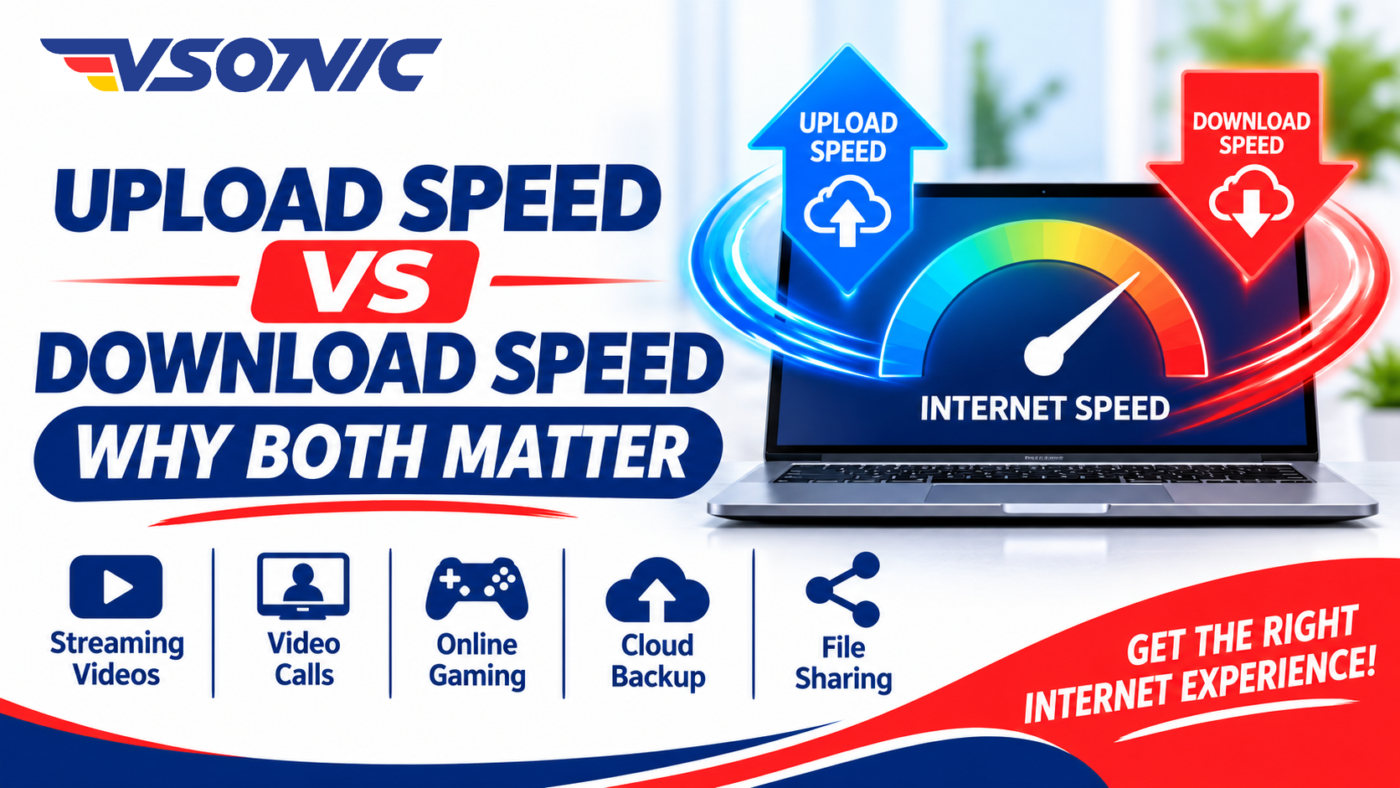
Have you ever tried downloading a file, streaming a video, joining a video call or sending a large document online and wondered why your internet connection feels slow, even though your internet plan promises high speeds? The answer may have something to do with the difference between upload speed vs download speed.
While many people focus almost entirely on download speed when choosing an internet plan, upload speed is equally important for several everyday activities. From video conferencing and online gaming to cloud backups, content creation and running a business online, both speeds influence how well your internet connection performs.
Understanding upload speed vs download speed can help you choose the right internet plan, troubleshoot connectivity problems and get more value from your internet service.
What Is Download Speed?
Download speed refers to how quickly your internet connection receives data from the internet to your device.
Whenever you open a website, watch a YouTube video, download an application, stream music or receive a file, your device is downloading information.
Download speed is typically measured in megabits per second (Mbps). The higher the download speed, the faster your connection can receive data, assuming other factors remain favourable.
What activities depend on download speed?
Download speed is particularly important for:
- Streaming movies and TV shows.
- Downloading software and applications.
- Browsing websites.
- Receiving files and documents.
- Online gaming downloads and updates.
- Streaming music.
- Loading online content.
For example, a faster download speed can reduce the time it takes to download a large software update or load high-resolution video content.
What Is Upload Speed?
Upload speed refers to how quickly your internet connection sends data from your device to the internet.
Whenever you send an email with attachments, upload pictures, share videos, join a video conference or back up files to cloud storage, your device is uploading data.
Like download speed, upload speed is measured in Mbps.
However, upload speed is often lower than download speed on many conventional broadband internet plans.
What activities depend on upload speed?
Upload speed is important for:
- Sending emails with large attachments.
- Uploading videos to YouTube and social media.
- Video conferencing.
- Live streaming.
- Cloud storage and backups.
- Sharing files online.
- Remote work.
- Online gaming communication.
For instance, a content creator uploading a large video to a platform may spend significantly less time waiting when their internet connection offers higher upload speeds.
Upload Speed vs Download Speed: What Is the Difference?
The easiest way to understand the difference is to imagine your internet connection as a two-way road.
Download speed represents how quickly information travels towards your device, while upload speed represents how quickly information leaves your device and travels to the internet.
| Feature | Download speed | Upload speed |
|---|---|---|
| Direction | Internet to your device | Your device to the internet |
| Purpose | Receiving information | Sending information |
| Common activities | Streaming, browsing, downloads | Video calls, uploads, backups |
| Higher speed helps | Load content faster | Send data faster |
| Measurement | Mbps | Mbps |
Both speeds contribute to your overall internet experience. However, the importance of each depends on how you use your connection.
Why Upload Speed Matters More Than You Think
1. Video Conferencing and Online Meetings
If you regularly attend Zoom, Google Meet or Microsoft Teams meetings, upload speed plays an important role.
During a video call, your device receives video and audio from other participants while simultaneously sending your own video and audio.
Therefore, insufficient upload speed may contribute to poor video quality, interruptions or difficulties transmitting your camera feed, especially when your connection is congested.
2. Working from Home
Remote workers often rely on cloud-based applications, document sharing, video conferencing and remote access tools.
Although downloading files and opening applications requires download speed, sending documents, sharing screens and participating in online meetings also depend on upload performance.
Consequently, a connection with adequate upload speed can make working from home considerably more comfortable.
3. Content Creation and Social Media
If you create videos, photographs, podcasts or other digital content, upload speed can directly influence how efficiently you work.
Uploading large video files, transferring footage to cloud storage and sharing content across social media platforms can take considerable time on a slow upload connection.
Furthermore, livestreaming requires a stable upload connection to transmit video and audio to viewers without interruptions.
4. Cloud Storage and Online Backups
Services such as Google Drive, OneDrive and other cloud platforms rely on your internet connection to transfer files.
Uploading documents, photographs, videos and backups requires upload speed. Therefore, a slow upload connection may cause backups to take longer, particularly when handling large amounts of data.
5. Online Gaming
Online gaming is not necessarily dependent on extremely high download or upload speeds. Instead, stability, latency and packet loss also matter considerably.
However, upload speed is important because your computer or gaming console sends information about your actions, movements and interactions to the game server.
If your upload connection becomes congested, it may contribute to lag or inconsistent gameplay.
What Is a Good Upload and Download Speed?
The internet speed you need depends on the number of connected devices, the activities you perform and whether several people use the connection simultaneously.
Here are some general guidelines for typical household usage:
| Internet activity | Suggested download speed | Suggested upload speed |
|---|---|---|
| Basic browsing and messaging | 5–10 Mbps | 1–3 Mbps |
| HD video streaming | 10–25 Mbps | 3–5 Mbps |
| Online meetings | 10–25 Mbps | 3–10 Mbps |
| Remote work and cloud sharing | 25–50 Mbps | 5–15 Mbps |
| Multiple users and devices | 50–100 Mbps or more | 10–25 Mbps or more |
| Heavy uploads and livestreaming | 50 Mbps or more | 10–25 Mbps or more |
<text color=”secondary” size=”sm”>These are practical planning estimates, not universal minimum requirements or guarantees. Actual requirements vary depending on the application, video quality, household usage and connection stability.</text>
Why Is My Upload Speed Slower Than My Download Speed?
Many internet service providers offer broadband plans where download speeds are significantly higher than upload speeds.
This is common with certain broadband technologies and service packages designed primarily around downloading content.
However, slow upload speeds may also result from:
- Network congestion.
- Poor Wi-Fi signal.
- An overloaded router.
- Too many devices using the connection.
- Interference from other wireless devices.
- Limitations of your internet plan.
- Problems with your internet service provider.
Therefore, if your upload speed is consistently lower than expected, check your internet plan and perform a speed test using a reliable testing service.
For a more accurate result, test your connection using an Ethernet cable where possible, especially when troubleshooting router or Wi-Fi problems.
How Can You Improve Your Upload and Download Speeds?
If your internet connection feels slow, consider these practical steps:
- Position your router properly: Place it in a central, open location rather than hiding it behind furniture or inside a cabinet.
- Use Ethernet: A wired connection can provide more consistent performance for computers, smart TVs and other compatible devices.
- Reduce unnecessary connections: Disconnect devices that are not actively being used.
- Upgrade your router: An older router may struggle to handle modern devices and demanding internet activities.
- Choose a suitable internet plan: If you frequently upload videos, participate in meetings or back up files, consider a plan with better upload speeds.
- Check for congestion: Large downloads, backups and uploads happening simultaneously may affect performance.
Final Thoughts
Upload speed and download speed are both essential parts of a good internet connection. Download speed helps you receive information quickly, while upload speed allows you to send information efficiently.
Although download speed often receives more attention, upload speed becomes increasingly important when working remotely, attending online meetings, sharing files, creating content or managing multiple connected devices.
Before choosing an internet plan, consider how you use the internet every day, the number of devices connected to your network and the upload speed your activities require.
At VSONIC.NG, we help you discover technology products that make everyday connectivity, productivity and digital experiences better. Explore our connectivity devices, routers and networking accessories to build a more reliable internet setup.
VSONIC.NG – Everything Tech. One Platform. One VSONIC.