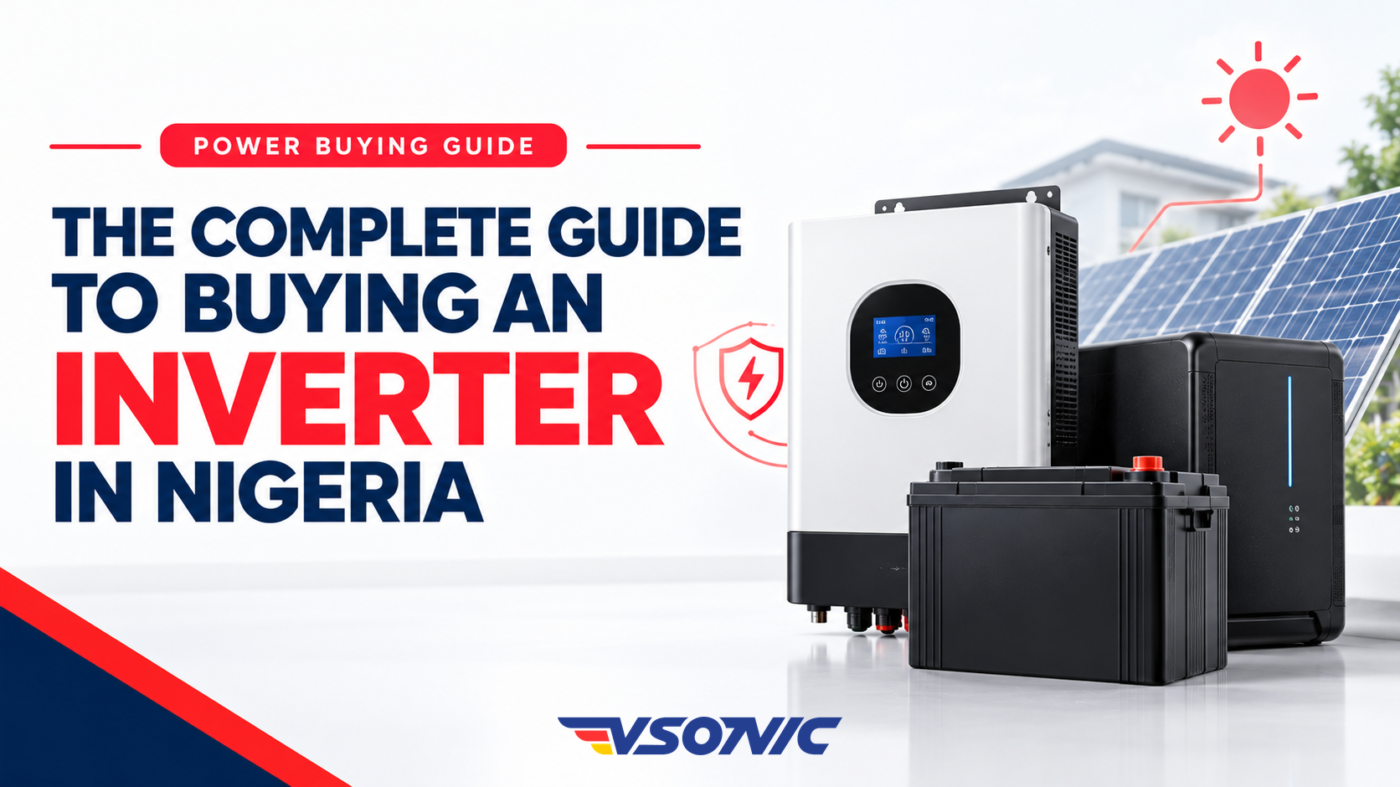
Power interruptions can disrupt your work, business operations, internet connection and everyday comfort. In Nigeria, investing in a reliable inverter system can help keep essential appliances running when public electricity supply fails.
However, choosing the right inverter involves more than comparing prices or buying the highest capacity you can afford. You need to consider your power requirements, battery capacity, backup duration, inverter type and installation costs.
This guide explains what to look for when buying an inverter in Nigeria so you can make a smarter investment for your home or business.
1. Understand How an Inverter Works
An inverter converts electricity stored in batteries from direct current (DC) into alternating current (AC), which most household and office appliances use.
A typical inverter system may include an inverter, batteries, charging equipment, protective devices and, where applicable, solar panels.
Remember that an inverter does not generate electricity on its own. Its backup duration depends on the available battery energy, the appliances connected and the efficiency of the system.
2. Choose the Right Inverter Capacity
Before buying an inverter, identify the appliances you want to power during an outage.
These may include:
- LED lights and ceiling fans
- Television and Wi-Fi router
- Laptop and desktop computers
- Refrigerator or freezer
- Air conditioner and other high-power appliances
Check the rated wattage of each appliance and calculate the total load you expect to run simultaneously. You must also account for starting surges from appliances with motors or compressors.
Here is a general starting guide:
| Inverter capacity | Typical application |
|---|---|
| 1–1.5kVA | Basic lighting, fans, TV and internet |
| 2–3.5kVA | More essential appliances and selected household electronics |
| 5kVA | Larger household loads or small offices |
| 8kVA and above | Higher-demand homes and commercial applications |
These are indicative ranges, not guarantees. Always check the inverter’s actual wattage output and surge rating before purchasing.
Important: A larger inverter can handle more appliances at once, but it does not automatically provide longer backup time. Battery capacity determines how much energy is available.
3. Decide Between a Standard, Solar or Hybrid Inverter
Different inverter types suit different needs.
Standard backup inverter: Suitable for powering selected appliances using batteries charged from the grid or another compatible source.
Solar inverter: Designed for solar energy systems, although features vary by model. Check whether the specific unit supports batteries and backup operation.
Hybrid inverter: Can coordinate compatible solar panels, batteries and grid electricity, depending on its features. It is worth considering if you want to integrate solar power or expand your system later.
Before buying, verify the product specifications, supported battery types and solar input limits. Not every inverter marketed as solar-ready offers the same capabilities.
4. Select the Right Inverter Battery
Your battery determines how much energy is available during a power interruption.
Common options include:
- Tubular batteries: Often chosen for stationary backup systems and relatively affordable initial costs.
- AGM and GEL batteries: Sealed lead-acid options with specific charging and operating requirements.
- Lithium batteries: Generally lighter and capable of offering greater usable capacity and longer cycle life, depending on the model and usage conditions.
When comparing batteries, consider capacity, warranty, maintenance, charging compatibility and expected lifespan.
Ensure that your inverter supports the battery’s voltage, chemistry and charging requirements. Using incompatible equipment can damage the battery or reduce its service life.
5. Estimate Your Backup Time
The amount of time your inverter can power appliances depends on battery capacity and electricity consumption.
For example, a 12V, 200Ah battery has a nominal energy capacity of:
12V × 200Ah = 2,400Wh, or 2.4kWh.
Not all this energy will be available to your appliances because of discharge limits and conversion losses.
If a system delivers approximately 1,500Wh of usable energy to appliances consuming 300W, the estimated runtime is five hours.
Actual performance varies according to battery chemistry, condition, inverter efficiency and the connected load.
If you need overnight backup, calculate the energy required throughout those hours rather than choosing a battery based only on its amp-hour rating.
6. Choose Pure Sine Wave Output
A pure sine wave inverter produces an AC waveform similar to mains electricity and is generally a good choice for modern home and office appliances.
It can be suitable for electronics, fans, refrigerators and other equipment when the inverter is correctly sized.
Modified sine wave models may cost less, but compatibility can be limited for certain appliances. Check your equipment’s requirements before buying.
For many households and businesses, a suitable pure sine wave inverter is a sensible option.
7. Check Compatibility, Safety and Reliability
Before purchasing, confirm that the inverter works with your intended appliances, batteries and charging equipment.
Also consider:
- Build quality: Choose a model from a reputable manufacturer.
- Warranty: Check the coverage, duration and service arrangements.
- Protection features: Verify the availability of appropriate overload, short-circuit and battery protection.
- Solar compatibility: Confirm the supported panel configuration if you plan to add solar.
- Installation: Use a qualified installer to assess wiring, cable sizes, protective devices, ventilation and earthing.
Never connect an inverter directly to household wiring without proper changeover equipment and protection. Incorrect installation can cause electric shock, fire or dangerous backfeeding into the electricity supply.
8. Budget for the Complete System
The inverter unit is only one part of the overall cost. Your budget may also need to cover batteries, wiring, circuit protection, installation and solar panels.
When comparing inverter prices in Nigeria, consider the complete package rather than choosing solely by the lowest advertised price.
Check product authenticity, warranty conditions, after-sales support and the total cost of installation. Prices and availability vary by capacity, brand, battery technology and market conditions.
The best inverter is not necessarily the most expensive. It is the one that meets your requirements safely and reliably within your budget.
9. Avoid Common Inverter Buying Mistakes
Avoid these common errors:
- Buying an inverter without calculating your appliance load.
- Assuming a large inverter automatically provides longer backup.
- Ignoring the starting requirements of refrigerators and air conditioners.
- Pairing an inverter with an incompatible battery.
- Expecting a solar-ready inverter to support every solar configuration.
- Overlooking installation, protection equipment and warranty terms.
- Relying on a single backup copy of important data or business files.
For better power resilience, maintain your equipment properly and consider whether a compatible solar system or additional battery capacity would meet your longer-term needs.
Frequently Asked Questions
What size inverter is best for a Nigerian home?
The right size depends on your appliances, simultaneous power demand and starting surges. Calculate your load before choosing an inverter capacity.
Which battery is best for an inverter in Nigeria?
Tubular batteries may suit buyers prioritising initial affordability, while lithium batteries can offer greater usable capacity and longer cycle life. Compare the specifications, compatibility and warranty before deciding.
Can an inverter power an air conditioner?
Yes, if the inverter and battery system can handle the air conditioner’s running consumption and starting requirements.
Can I add solar panels to my inverter?
Only if the inverter supports solar input or is compatible with a properly designed additional solar system. Confirm this with the manufacturer or a qualified installer.
Conclusion
Buying the right inverter in Nigeria starts with understanding your power needs. Calculate your appliance load, choose an appropriate capacity, select a compatible battery and consider whether solar integration would benefit your home or business.
Do not overlook pure sine wave output, installation quality, safety features and warranty support. Evaluating the complete system will help you avoid unnecessary expenses and choose a solution that meets your backup requirements.
Looking for technology and power solutions for your home or business? Explore VSONIC.NG for technology products and electronics in Nigeria.