
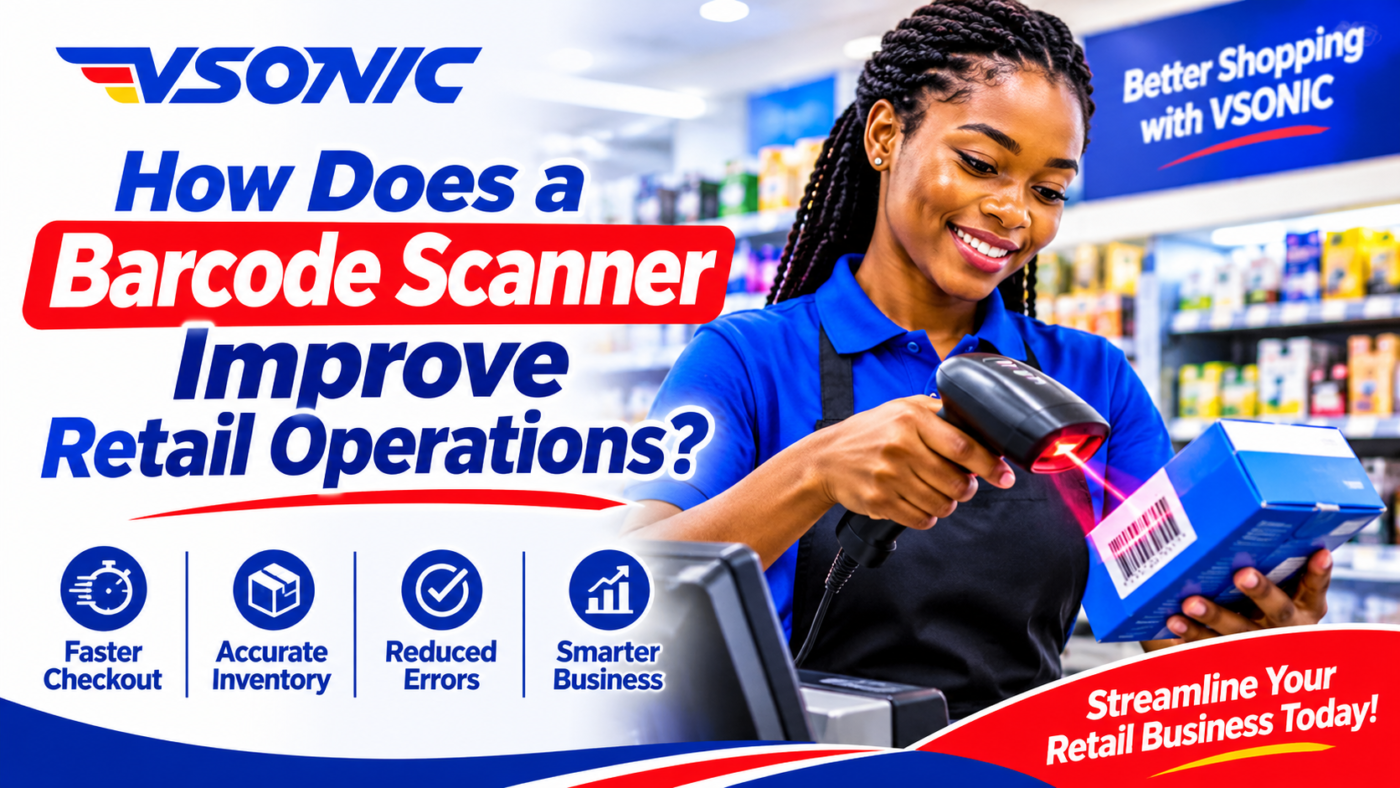
From supermarkets and pharmacies to boutiques, electronics stores, warehouses and wholesalers, barcode scanners help retailers capture product information quickly, simplify checkout and improve inventory management. But how exactly does a barcode scanner improve retail operations, and why has it become an important tool for modern retail businesses?
Running a retail business involves much more than displaying products and serving customers. Retailers must keep track of inventory, process transactions accurately, manage stock replenishment and ensure customers have a smooth shopping experience.
As the number of products and daily transactions increases, handling these tasks manually can become time-consuming and prone to errors.
This is where barcode scanners make a difference.
What Is a Barcode Scanner?
A barcode scanner is an electronic device that reads barcodes printed on product packaging, labels or tags and converts the encoded information into data that a computer or retail management system can process.
When a barcode is scanned, the connected system retrieves the associated product information, which may include the product name, price, stock details, SKU or other relevant data.
Depending on the scanner and software, retailers can use barcode scanners at checkout counters, in stockrooms, during receiving and for inventory counting.
Common types include handheld barcode scanners, wireless scanners, presentation scanners and fixed-position scanners.
7 Ways Barcode Scanners Improve Retail Operations
1. Faster Checkout and Improved Customer Experience
One of the most visible benefits of barcode scanners is faster checkout.
Instead of manually entering product names, codes or prices, cashiers scan the product barcode to retrieve its information from the point-of-sale (POS) system.
This simplifies transactions, reduces unnecessary delays and helps retailers serve customers more efficiently, particularly during busy periods.
For supermarkets, convenience stores and high-volume retail outlets, efficient checkout processes can make a meaningful difference to the shopping experience.
2. More Accurate Inventory Management
Keeping accurate inventory records is essential for every retailer. Without reliable stock information, businesses may struggle to identify what is available, what needs replenishment or which products are missing.
Barcode scanners simplify stock tracking by allowing employees to scan products during receiving, stock transfers, sales and inventory counts.
When properly integrated with inventory management software, these activities can update stock records automatically, helping retailers maintain more accurate inventory information.
3. Reduced Manual Errors
Manual data entry creates opportunities for mistakes. Employees may enter incorrect product codes, quantities or prices, especially when handling many products throughout the day.
Barcode scanning reduces the need for repeated manual entry by capturing product identification data directly.
Although barcode systems still depend on accurate product records, correct barcode labels and properly configured software, they can significantly reduce errors associated with manual processes.
4. Easier Stocktaking and Inventory Audits
Physical inventory counting can be demanding, particularly for businesses with large product collections.
Barcode scanners make stocktaking easier by allowing employees to scan products as they count them. Instead of recording product information manually, scanned data can be captured through compatible inventory software.
This can speed up stock counts, simplify reconciliation and help businesses identify discrepancies between recorded inventory and actual stock.
Retailers can also conduct smaller, regular cycle counts instead of relying exclusively on large periodic stock audits.
5. Better Stock Replenishment and Purchasing Decisions
Barcode scanners help retailers collect useful sales and inventory information.
When scanning activity is linked to a POS or inventory system, businesses can monitor product movement, identify fast-selling items and recognise products that are not selling as expected.
This information can support purchasing decisions and replenishment planning.
For example, a retailer can identify when popular products are approaching their minimum stock levels and reorder before shelves become empty.
However, automated reorder recommendations depend on properly configured inventory data and purchasing rules.
6. Improved Price Accuracy and Product Identification
Barcode scanners retrieve product information from the retailer’s database, helping ensure that the correct item and its associated price are recorded during checkout.
This reduces the need for cashiers to memorise prices or manually enter them for every product.
Retailers can also update product prices in their POS systems, allowing compatible checkout systems to retrieve the revised prices when items are scanned.
Properly maintained product databases and price records remain essential to ensuring customers are charged correctly.
7. Improved Retail Reporting and Business Insights
Barcode scanning generates useful operational data when connected to retail software.
Retailers can analyse sales records, product movement, stock levels and transaction information to better understand how their businesses operate.
These insights may help identify popular products, slow-moving stock, purchasing patterns and opportunities to improve merchandising.
Instead of relying entirely on assumptions, retailers can make more informed decisions using their recorded sales and inventory data.
What Does a Retailer Need to Use Barcode Scanners?
A barcode scanner alone may not provide all the benefits described above. A functional retail barcode system generally requires:
- Barcode scanner: A compatible device for reading product barcodes.
- POS software: To process transactions and retrieve product information.
- Inventory management system: To track stock movements and quantities where needed.
- Barcode labels: Product identifiers that the system can recognise.
- Computer or POS terminal: To run the software and manage transactions.
The components should be compatible and properly configured to work together.
Are Barcode Scanners Worth It for Small Retail Businesses?
Yes. Barcode scanners can benefit small shops, pharmacies, boutiques, electronics stores, supermarkets and wholesalers.
Even businesses with relatively small inventories can use barcode scanning to simplify checkout, improve stock records and reduce manual data entry.
The key is choosing equipment that suits the business’s product volume, budget, software and operational requirements.
A small shop may need only a basic scanner connected to a POS terminal, while a larger retailer may require wireless scanners, multiple checkout stations and integrated inventory management.
Improve Your Retail Operations with the Right Technology
Barcode scanners help retailers streamline checkout, improve stock visibility, simplify inventory counting and make better use of sales data.
When integrated with compatible POS and inventory management systems, barcode scanning can reduce manual processes and support more efficient retail operations.
Whether you’re running a supermarket, pharmacy, boutique, electronics store or wholesale business, investing in the right retail technology can help you work smarter and serve customers better.
Explore VSONIC.NG for office electronics, computing products, connectivity devices and technology solutions that support modern retail and business operations.
VSONIC.NG – Everything Tech. One Platform. One VSONIC.