
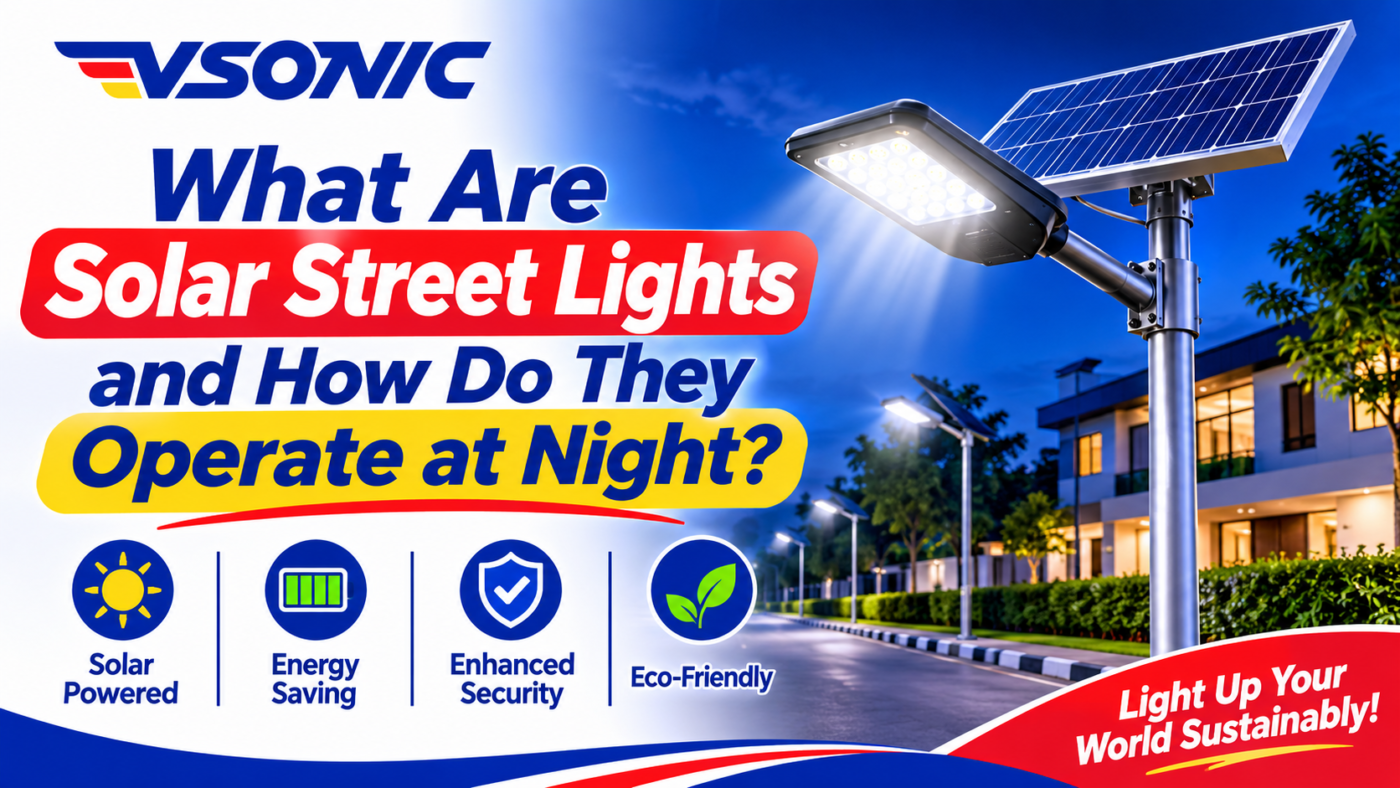
Imagine a street, compound, car park or walkway that remains illuminated at night without relying directly on electricity from the grid. That is one of the practical advantages of solar street lights.
With the use sunlight to generate and store electrical energy during the day, they illuminate outdoor spaces after sunset. They are increasingly useful for residential compounds, estates, roads, schools, business premises, parking areas and other locations where outdoor lighting is needed.
But what exactly are solar street lights, how do they work at night, and what should you consider before installing one? Let’s take a closer look.
What Are Solar Street Lights?
They are outdoor lighting systems that use solar energy to power LED lights, usually without requiring a direct connection to the electricity grid, this is particularly important in areas that don’t have power supply.
They typically consist of a solar panel, rechargeable battery, charge controller, LED light and mounting structure. Some models also include motion sensors, automatic light sensors and programmable lighting settings.
Unlike conventional streetlights that depend on grid electricity, solar street lights generate and store their own energy, making them useful for locations where grid access is limited, unreliable or expensive.
How Do Solar Street Lights Work?
They operate through a simple process of energy generation, storage and automatic lighting.
1. Solar Panels Capture Sunlight During the Day
The solar panel contains photovoltaic cells that convert sunlight into electrical energy.
During daylight hours, the panel generates electricity. The amount produced depends on sunlight intensity, panel orientation, shading, weather conditions and the panel’s capacity.
Proper positioning is important because shaded or poorly positioned panels may produce less energy than expected.
2. The Charge Controller Regulates Energy
The electricity generated by the solar panel passes through a charge controller.
The controller manages the charging process, regulates the energy supplied to the battery and helps prevent conditions such as overcharging or excessive battery discharge, depending on its design.
In many of them, the controller also manages the automatic lighting cycle, including switching the light on at night and off during the day.
3. The Battery Stores Energy
The rechargeable battery stores the electricity generated during the day for nighttime use.
Battery capacity determines how much energy the system can store, although usable energy also depends on battery chemistry, operating limits, efficiency and other factors.
A properly sized battery helps the light operate through the night and may provide reserve energy during periods of limited sunlight.
4. The LED Light Illuminates the Area at Night
When the surrounding light level drops at sunset, the controller automatically activates the LED light using energy stored in the battery.
LEDs are commonly used because they provide illumination efficiently relative to many conventional lighting technologies.
Depending on the design, the light may operate at full brightness throughout the night, dim during quieter hours or increase brightness when movement is detected.
5. The System Automatically Resets at Dawn
When daylight returns, the controller detects the change in light conditions and switches off the LED.
The solar panel then begins another charging cycle, replenishing the battery for the following night.
This automatic operation allows most solar street lights to function without manual switching every day.
Types of Solar Street Lights
Solar street lights are available in different configurations depending on their design and installation requirements.
All-in-one solar street lights: These integrate the solar panel, battery, LED and controller into a single unit. They are compact and convenient to install.
Split solar street lights: These have separate solar panels and lighting units, with the battery and controller positioned within the system’s components. This arrangement allows greater flexibility in panel positioning and system configuration.
Motion-sensor solar street lights: These use motion detection to adjust brightness or activate illumination when movement is detected. Some remain dim when inactive and brighten when someone approaches, helping conserve stored energy.
Choosing the appropriate design depends on the lighting requirements, installation location, budget and expected operating hours.
Where Can Solar Street Lights Be Used?
Solar street lights are useful in many outdoor environments.
- Residential estates and compounds: Illuminate driveways, walkways, gates and shared spaces.
- Roads and streets: Provide lighting in selected locations where grid infrastructure is unavailable or costly to extend.
- Schools and campuses: Illuminate pathways, entrances, outdoor facilities and selected common areas.
- Business premises: Improve visibility around offices, shops, warehouses and commercial properties.
- Parking areas: Provide illumination for vehicle movement and pedestrian access.
- Rural and remote locations: Support outdoor lighting where connecting to the electricity grid may be difficult.
The appropriate lighting output, installation height and spacing depend on the location and the intended use.
Do Solar Street Lights Work During Cloudy or Rainy Weather?
Yes, solar street lights can continue operating during cloudy or rainy weather because they rely on energy stored in their batteries.
However, cloudy conditions may reduce solar panel output. If the battery receives insufficient charging over several days, the light may operate for fewer hours or reduce its brightness, depending on the controller.
For reliable operation, consider the panel capacity, battery size, expected lighting duration, weather conditions, installation location and reserve capacity.
Solar street lights are not equally reliable in every configuration. Choosing a properly designed system matters more than simply buying a light with an impressive advertised wattage.
What Should You Consider When Buying Solar Street Lights?
Before purchasing a solar street light, consider the following:
- LED brightness: Check the actual lighting output in lumens where available, rather than relying exclusively on advertised wattage.
- Battery capacity: Confirm the battery specifications and expected operating duration.
- Solar panel capacity: Ensure the panel can adequately recharge the battery under the expected conditions.
- Lighting duration: Understand how many hours the light is designed to operate and whether it dims during the night.
- Motion sensor: Check whether the light includes motion detection and how its brightness changes.
- Weather resistance: Look for an appropriate IP rating for outdoor exposure.
- Installation requirements: Consider mounting height, positioning, pole requirements and potential shading.
- Warranty and support: Check warranty coverage, battery replacement arrangements and product support.
Avoid choosing a solar street light solely because its advertised wattage is higher. Battery capacity, panel performance, lighting efficiency and system design all influence how well it works.
Are Solar Street Lights Worth It?
Solar street lights can be a practical outdoor lighting solution for homes, businesses, estates, schools and other locations.
They reduce dependence on grid electricity, can operate during power outages and may simplify installation where extending electrical wiring is difficult. However, their performance depends on proper sizing, installation, sunlight exposure, battery quality and maintenance.
For buyers looking to illuminate outdoor spaces more conveniently, solar street lights offer a useful combination of energy generation, storage and automatic lighting.
Illuminate Your Outdoor Spaces with Solar Technology
Solar street lights combine solar panels, rechargeable batteries, controllers and LED lighting to provide automatic illumination after dark.
Whether you’re lighting a residential compound, business premises, driveway, estate, parking area or outdoor walkway, choosing the right system can help you achieve dependable lighting without relying directly on grid electricity.
Explore VSONIC.NG for power supply equipment, lighting solutions and technology products designed to support homes, businesses and everyday needs.
VSONIC.NG – Everything Tech. One Platform. One VSONIC.